
If low water on the Danube or Rhine is what’s keeping you from booking, look at the Seine, the Rhône, the Douro, or a spring sailing through the Dutch waterways.
This is the question I’ve answered more than any other this year. In 2026 the water dropped, sailings changed, and every line handled it differently. My own mom sailed on a low river this fall. So now, before anyone asks me which line or which cabin, they ask: which rivers don’t do this?
Short answer: these four don’t have the same low-water problem. Here’s why, where each one sails from, and what each one asks of you in return.

Why the Danube and Rhine get hit
It comes down to one thing: whether something is holding the water in place.
The Danube and Rhine both have long free-flowing stretches. On the Rhine, it’s the castle stretch, the exact part everyone books for. On the Danube, it’s the section in Bavaria between Regensburg and Passau. Nothing holds the water back there, so the depth rises and falls with Alpine snowmelt and rain.
Dry summer? The river drops, ships can’t pass, and you spend a day on a motor coach or swap ships mid-cruise. Wet spring? The river rises, and the ship can’t fit under the bridges.
The four rivers below are managed. A chain of dams and locks holds the water at a set depth, and the ships step up and down through the locks like an elevator. When it doesn’t rain for a month, the dams still hold enough water to sail.
That doesn’t make them weatherproof. Low water almost never stops a sailing on these rivers. High water after heavy rain still can. Anyone who tells you a river is guaranteed is selling you something.
The Seine: Paris romance + history
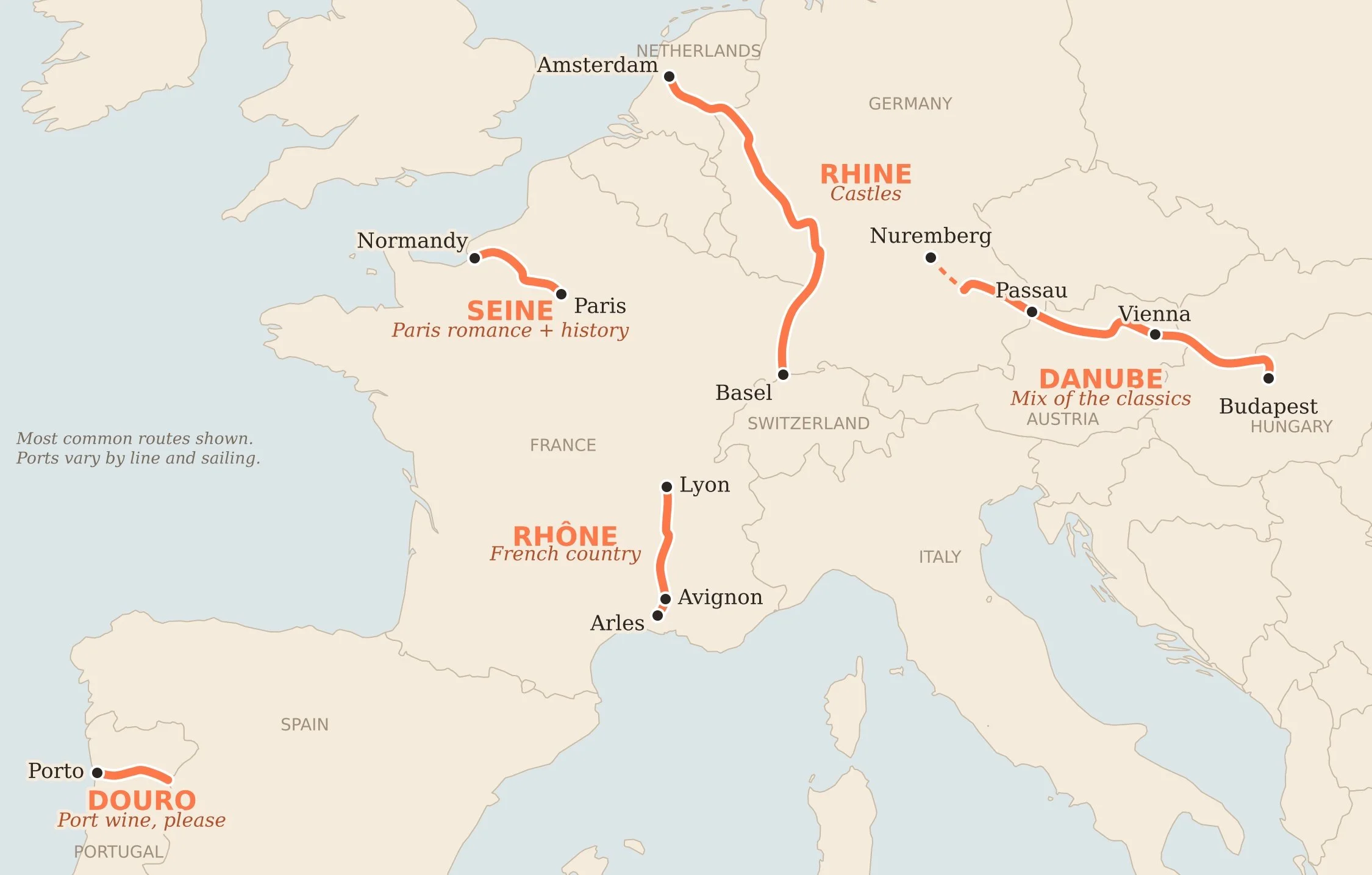
Sails from: Paris, round trip
Fly into and home from: Paris
You’ll see: Monet’s gardens at Giverny, Rouen, and the Normandy beaches
Why it holds up: Locks and weirs run the length of the river from Paris to Rouen, and reservoirs upstream release water in the dry months. Low water just isn’t the Seine’s problem.
The catch: high water. After a really wet winter or spring, Paris floods, and ships can’t fit under the bridges. If a Seine sailing gets disrupted, that’s almost always why. And the Normandy beaches are a long coach day, so you’re not floating up to Omaha Beach.
Why I’m pointing people here right now: with Air France’s nonstop from Nashville to Paris, this is the easiest river cruise to get to from home. No connection, no repositioning. Add a few nights in Paris before you board, and if you’ve never been, that pairing is hard to beat.Why it holds up: Locks and weirs run the length of the river from Paris to Rouen, and reservoirs upstream release water in the dry months. Low water just isn’t the Seine’s problem.
The catch: high water. After a really wet winter or spring, Paris floods, and ships can’t fit under the bridges. If a Seine sailing gets disrupted, that’s almost always why. And the Normandy beaches are a long coach day, so you’re not floating up to Omaha Beach.
Why I’m pointing people here right now: with Air France’s nonstop from Nashville to Paris, this is the easiest river cruise to get to from home. No connection, no repositioning. Add a few nights in Paris before you board, and if you’ve never been, that pairing is hard to beat.
The Rhône: French country
Sails from: Lyon to Avignon or Arles (some lines run it round trip from Lyon, or start farther north in Burgundy)
Fly into: Lyon. Fly home from: Marseille.
You’ll see: Lyon’s food scene, Roman ruins, lavender country, and the Palace of the Popes
Why it holds up: the Rhône is dammed for hydropower almost all the way from Lyon to the sea, and it’s fed by Lake Geneva and the Alps. The depth stays remarkably steady, dry summer or not.
The catch: big fall storms can push the current up and slow things down, and the mistral (a strong wind that blows down the valley) can delay docking. Neither one puts you on a bus for three days. Also, Provence in July is hot. Plan for it.
Why I’m pointing people here right now: this is the pick for people who wanted the Rhine for the wine and the villages but are nervous about the water. You trade castles for Provence, and you eat better doing it.
The Douro: port wine, please
Sails from: Porto, round trip (many itineraries cross into Spain and include a day in Salamanca)
Fly into and home from: Porto, or Lisbon if you add it on
You’ll see: terraced vineyards, quintas pouring tastings, and the slowest, prettiest scenery on any river
Why it holds up: five dams with locks hold the Douro in place. One of them, Carrapatelo, is among the tallest river locks in Europe, and going through it is a highlight, not an inconvenience. Low water is basically not a thing here.
The catch: the Douro floods in winter, which is why the season pauses then. And July and August in the valley regularly hit 100°F. The ships are smaller, there’s a lot of time on coaches to reach the towns, and you’re not getting big-city days. This is a wine-and-scenery trip.
Why I’m pointing people here right now: if you love wine and want a river that just reliably sails, this is it. Go in spring or early fall, and stay a few nights in Porto. Add Lisbon by train if you have the time.
The Dutch and Belgian waterways: tulip time
Why it holds up: if anyone on earth knows how to control water, it’s the Dutch. These routes run on canals and delta channels whose levels are managed very tightly. A dry spell upstream doesn’t strand you here.
The catch: some itineraries spend part of the trip on branches of the Rhine, and wind on big open water like the IJsselmeer can occasionally change the route. The bigger catch is the calendar: tulip season is a short spring window, and it books out early.
Why I’m pointing people here right now: if spring is your season and the Rhine was on your list, this gives you a lot of the same Amsterdam magic with much less water worry. Pack a rain jacket. It’s the Netherlands in April.
This is one piece of how I think about river cruises. If you want the full picture — what to know before booking, how the major lines compare, and the stuff most people don't think about until it's too late. I put it all in one place HERE
The honest trade-off
More reliable doesn’t mean better for you. Each of these is a different trip, not a safer copy of the Danube.
And if the Danube or Rhine is the trip you actually want? Don’t write it off. Go knowing low water tends to show up late in the season and high water in spring, book a line whose low-water policy you understand before you pay, and buy the travel insurance. That’s the exact conversation I had with my mom before her sailing.
👉 Read: You don't need a travel advisor to book your river cruise — but here's what most people wish they'd known first.
Pick the river, then pick the line
The river decides where the water can and can’t surprise you. The line decides almost everything else: who welcomes kids, who charges solo travelers extra, what’s actually included, and who it’s really built for. I put 10 lines side by side in my free river cruise comparison guide. And when it comes to how a line handles high or low water, that’s a conversation we have before you book, not after.